最小二乗法
[1]:
%matplotlib inline
[2]:
import matplotlib.pyplot as plt
import numpy as np
import pandas as pd
import statsmodels.api as sm

np.random.seed(9876789)
OLS推定
人工的なデータ:
[3]:
nsample = 100
x = np.linspace(0, 10, 100)
X = np.column_stack((x, x ** 2))
beta = np.array([1, 0.1, 10])
e = np.random.normal(size=nsample)
モデルには切片が必要なので、1 の列を追加します:
[4]:
X = sm.add_constant(X)
y = np.dot(X, beta) + e
フィットとサマリ:
[5]:
model = sm.OLS(y, X)
results = model.fit()
print(results.summary())
                            OLS Regression Results
==============================================================================
Dep. Variable:                      y   R-squared:                       1.000
Model:                            OLS   Adj. R-squared:                  1.000
Method:                 Least Squares   F-statistic:                 4.020e+06
Date:                Thu, 28 Nov 2024   Prob (F-statistic):          2.83e-239
Time:                        23:10:54   Log-Likelihood:                -146.51
No. Observations:                 100   AIC:                             299.0
Df Residuals:                      97   BIC:                             306.8
Df Model:                           2
Covariance Type:            nonrobust
==============================================================================
                 coef    std err          t      P>|t|      [0.025      0.975]
------------------------------------------------------------------------------
const          1.3423      0.313      4.292      0.000       0.722       1.963
x1            -0.0402      0.145     -0.278      0.781      -0.327       0.247
x2            10.0103      0.014    715.745      0.000       9.982      10.038
==============================================================================
Omnibus:                        2.042   Durbin-Watson:                   2.274
Prob(Omnibus):                  0.360   Jarque-Bera (JB):                1.875
Skew:                           0.234   Prob(JB):                        0.392
Kurtosis:                       2.519   Cond. No.                         144.
==============================================================================

Notes:
[1] Standard Errors assume that the covariance matrix of the errors is correctly specified.
関心のある量は、フィットしたモデルから直接抽出することができます。完全なリストを表示するには、 dir(results) と入力します。以下に例を示します:
[6]:
print("Parameters: ", results.params)
print("R2: ", results.rsquared)
Parameters:  [ 1.34233516 -0.04024948 10.01025357]
R2:  0.9999879365025871
OLS非線形曲線、ただしパラメータは線形
xとyの間に非線形の関係を持つ人工的なデータをシミュレートします:
[7]:
nsample = 50
sig = 0.5
x = np.linspace(0, 20, nsample)
X = np.column_stack((x, np.sin(x), (x - 5) ** 2, np.ones(nsample)))
beta = [0.5, 0.5, -0.02, 5.0]

y_true = np.dot(X, beta)
y = y_true + sig * np.random.normal(size=nsample)
フィットとサマリ:
[8]:
res = sm.OLS(y, X).fit()
print(res.summary())
                            OLS Regression Results
==============================================================================
Dep. Variable:                      y   R-squared:                       0.933
Model:                            OLS   Adj. R-squared:                  0.928
Method:                 Least Squares   F-statistic:                     211.8
Date:                Thu, 28 Nov 2024   Prob (F-statistic):           6.30e-27
Time:                        23:10:54   Log-Likelihood:                -34.438
No. Observations:                  50   AIC:                             76.88
Df Residuals:                      46   BIC:                             84.52
Df Model:                           3
Covariance Type:            nonrobust
==============================================================================
                 coef    std err          t      P>|t|      [0.025      0.975]
------------------------------------------------------------------------------
x1             0.4687      0.026     17.751      0.000       0.416       0.522
x2             0.4836      0.104      4.659      0.000       0.275       0.693
x3            -0.0174      0.002     -7.507      0.000      -0.022      -0.013
const          5.2058      0.171     30.405      0.000       4.861       5.550
==============================================================================
Omnibus:                        0.655   Durbin-Watson:                   2.896
Prob(Omnibus):                  0.721   Jarque-Bera (JB):                0.360
Skew:                           0.207   Prob(JB):                        0.835
Kurtosis:                       3.026   Cond. No.                         221.
==============================================================================

Notes:
[1] Standard Errors assume that the covariance matrix of the errors is correctly specified.
その他の関連する数量を抽出します:
[9]:
print("Parameters: ", res.params)
print("Standard errors: ", res.bse)
print("Predicted values: ", res.predict())
Parameters:  [ 0.46872448  0.48360119 -0.01740479  5.20584496]
Standard errors:  [0.02640602 0.10380518 0.00231847 0.17121765]
Predicted values:  [ 4.77072516  5.22213464  5.63620761  5.98658823  6.25643234  6.44117491
  6.54928009  6.60085051  6.62432454  6.6518039   6.71377946  6.83412169
  7.02615877  7.29048685  7.61487206  7.97626054  8.34456611  8.68761335
  8.97642389  9.18997755  9.31866582  9.36587056  9.34740836  9.28893189
  9.22171529  9.17751587  9.1833565   9.25708583  9.40444579  9.61812821
  9.87897556 10.15912843 10.42660281 10.65054491 10.8063004  10.87946503
 10.86825119 10.78378163 10.64826203 10.49133265 10.34519853 10.23933827
 10.19566084 10.22490593 10.32487947 10.48081414 10.66779556 10.85485568
 11.01006072 11.10575781]
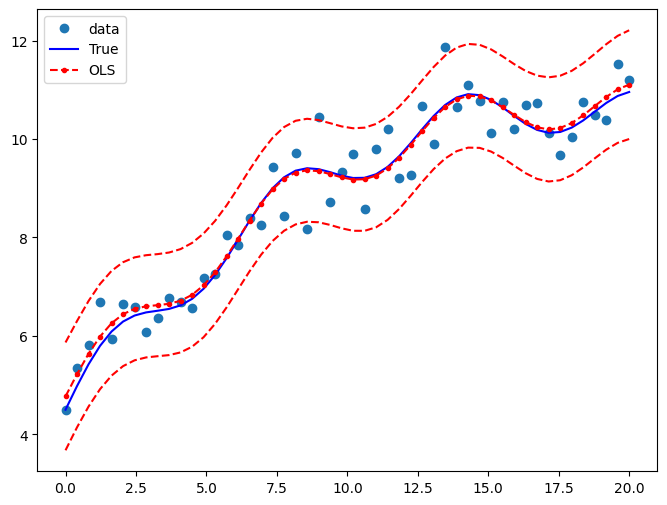
真の関係をOLS予測と比較するためのプロットを描画します。予測の信頼区間は、 wls_prediction_std コマンドを使用して構築されます。
[10]:
pred_ols = res.get_prediction()
iv_l = pred_ols.summary_frame()["obs_ci_lower"]
iv_u = pred_ols.summary_frame()["obs_ci_upper"]

fig, ax = plt.subplots(figsize=(8, 6))

ax.plot(x, y, "o", label="data")
ax.plot(x, y_true, "b-", label="True")
ax.plot(x, res.fittedvalues, "r--.", label="OLS")
ax.plot(x, iv_u, "r--")
ax.plot(x, iv_l, "r--")
ax.legend(loc="best")
[10]:
<matplotlib.legend.Legend at 0x23fc867fe80>
ダミー変数を使用した OLS
人工的なデータを生成します。ダミー変数を使用してモデル化される 3 つのグループがあります。グループ 0 は省略/ベンチマーク カテゴリです。
[11]:
nsample = 50
groups = np.zeros(nsample, int)
groups[20:40] = 1
groups[40:] = 2
# dummy = (groups[:,None] == np.unique(groups)).astype(float)

dummy = pd.get_dummies(groups).values
x = np.linspace(0, 20, nsample)
# drop reference category
X = np.column_stack((x, dummy[:, 1:]))
X = sm.add_constant(X, prepend=False)

beta = [1.0, 3, -3, 10]
y_true = np.dot(X, beta)
e = np.random.normal(size=nsample)
y = y_true + e
データを検査します:
[12]:
print(X[:5, :])
print(y[:5])
print(groups)
print(dummy[:5, :])
[[0.         0.         0.         1.        ]
 [0.40816327 0.         0.         1.        ]
 [0.81632653 0.         0.         1.        ]
 [1.2244898  0.         0.         1.        ]
 [1.63265306 0.         0.         1.        ]]
[ 9.28223335 10.50481865 11.84389206 10.38508408 12.37941998]
[0 0 0 0 0 0 0 0 0 0 0 0 0 0 0 0 0 0 0 0 1 1 1 1 1 1 1 1 1 1 1 1 1 1 1 1 1
 1 1 1 2 2 2 2 2 2 2 2 2 2]
[[ True False False]
 [ True False False]
 [ True False False]
 [ True False False]
 [ True False False]]
フィットとサマリ:
[13]:
res2 = sm.OLS(y, X).fit()
print(res2.summary())
                            OLS Regression Results
==============================================================================
Dep. Variable:                      y   R-squared:                       0.978
Model:                            OLS   Adj. R-squared:                  0.976
Method:                 Least Squares   F-statistic:                     671.7
Date:                Thu, 28 Nov 2024   Prob (F-statistic):           5.69e-38
Time:                        23:10:54   Log-Likelihood:                -64.643
No. Observations:                  50   AIC:                             137.3
Df Residuals:                      46   BIC:                             144.9
Df Model:                           3
Covariance Type:            nonrobust
==============================================================================
                 coef    std err          t      P>|t|      [0.025      0.975]
------------------------------------------------------------------------------
x1             0.9999      0.060     16.689      0.000       0.879       1.121
x2             2.8909      0.569      5.081      0.000       1.746       4.036
x3            -3.2232      0.927     -3.477      0.001      -5.089      -1.357
const         10.1031      0.310     32.573      0.000       9.479      10.727
==============================================================================
Omnibus:                        2.831   Durbin-Watson:                   1.998
Prob(Omnibus):                  0.243   Jarque-Bera (JB):                1.927
Skew:                          -0.279   Prob(JB):                        0.382
Kurtosis:                       2.217   Cond. No.                         96.3
==============================================================================

Notes:
[1] Standard Errors assume that the covariance matrix of the errors is correctly specified.
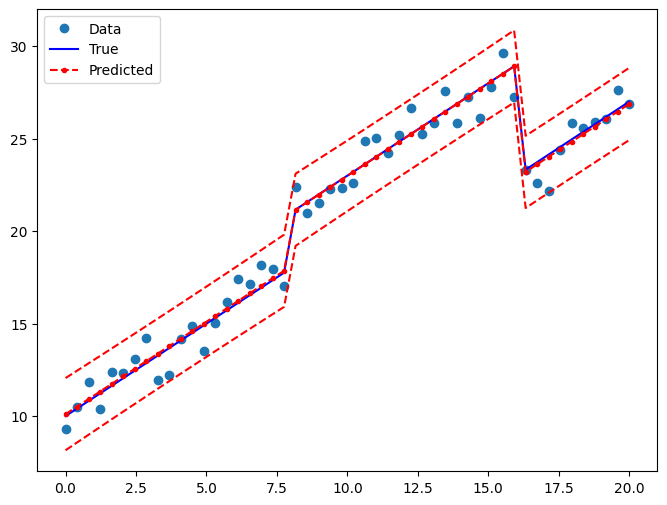
プロットを描いて、実際の関係を OLS 予測と比較します:
[14]:
pred_ols2 = res2.get_prediction()
iv_l = pred_ols2.summary_frame()["obs_ci_lower"]
iv_u = pred_ols2.summary_frame()["obs_ci_upper"]

fig, ax = plt.subplots(figsize=(8, 6))

ax.plot(x, y, "o", label="Data")
ax.plot(x, y_true, "b-", label="True")
ax.plot(x, res2.fittedvalues, "r--.", label="Predicted")
ax.plot(x, iv_u, "r--")
ax.plot(x, iv_l, "r--")
legend = ax.legend(loc="best")
結合仮説検定
F検定
ダミー変数の両方の係数がゼロであるという仮説、すなわち \(R \times \beta = 0\) を検定したいと考えています。F検定により、3 つのグループで定数が同一であるという帰無仮説を強く棄却することがわかります。
[15]:
R = [[0, 1, 0, 0], [0, 0, 1, 0]]
print(np.array(R))
print(res2.f_test(R))
[[0 1 0 0]
 [0 0 1 0]]
<F test: F=145.49268198028102, p=1.2834419617280512e-20, df_denom=46, df_num=2>
仮説を検定するために、数式のような構文を使用することもできます。
[16]:
print(res2.f_test("x2 = x3 = 0"))
<F test: F=145.49268198028074, p=1.2834419617280974e-20, df_denom=46, df_num=2>
小グループ効果
より小さなグループ効果を持つ人工的なデータを生成すると、T 検定は帰無仮説を棄却できなくなります:
[17]:
beta = [1.0, 0.3, -0.0, 10]
y_true = np.dot(X, beta)
y = y_true + np.random.normal(size=nsample)

res3 = sm.OLS(y, X).fit()
[18]:
print(res3.f_test(R))
<F test: F=1.224911192540921, p=0.30318644106311926, df_denom=46, df_num=2>
[19]:
print(res3.f_test("x2 = x3 = 0"))
<F test: F=1.2249111925409215, p=0.30318644106311926, df_denom=46, df_num=2>
多重共線性
Longleyデータセットは、多重共線性が高いことでよく知られています。つまり、外生的な予測変数同士が非常に高い相関を持っています。これは、モデルの仕様をわずかに変更した場合でも、係数推定の安定性に影響を及ぼす可能性があるため、問題となります。
[20]:
from statsmodels.datasets.longley import load_pandas

y = load_pandas().endog
X = load_pandas().exog
X = sm.add_constant(X)
フィットとサマリ:
[21]:
ols_model = sm.OLS(y, X)
ols_results = ols_model.fit()
print(ols_results.summary())
                            OLS Regression Results
==============================================================================
Dep. Variable:                 TOTEMP   R-squared:                       0.995
Model:                            OLS   Adj. R-squared:                  0.992
Method:                 Least Squares   F-statistic:                     330.3
Date:                Thu, 28 Nov 2024   Prob (F-statistic):           4.98e-10
Time:                        23:10:54   Log-Likelihood:                -109.62
No. Observations:                  16   AIC:                             233.2
Df Residuals:                       9   BIC:                             238.6
Df Model:                           6
Covariance Type:            nonrobust
==============================================================================
                 coef    std err          t      P>|t|      [0.025      0.975]
------------------------------------------------------------------------------
const      -3.482e+06    8.9e+05     -3.911      0.004    -5.5e+06   -1.47e+06
GNPDEFL       15.0619     84.915      0.177      0.863    -177.029     207.153
GNP           -0.0358      0.033     -1.070      0.313      -0.112       0.040
UNEMP         -2.0202      0.488     -4.136      0.003      -3.125      -0.915
ARMED         -1.0332      0.214     -4.822      0.001      -1.518      -0.549
POP           -0.0511      0.226     -0.226      0.826      -0.563       0.460
YEAR        1829.1515    455.478      4.016      0.003     798.788    2859.515
==============================================================================
Omnibus:                        0.749   Durbin-Watson:                   2.559
Prob(Omnibus):                  0.688   Jarque-Bera (JB):                0.684
Skew:                           0.420   Prob(JB):                        0.710
Kurtosis:                       2.434   Cond. No.                     4.86e+09
==============================================================================

Notes:
[1] Standard Errors assume that the covariance matrix of the errors is correctly specified.
[2] The condition number is large, 4.86e+09. This might indicate that there are
strong multicollinearity or other numerical problems.
C:\Users\user\projects\statsmodels-main\venv\lib\site-packages\scipy\stats\_axis_nan_policy.py:418: UserWarning: `kurtosistest` p-value may be inaccurate with fewer than 20 observations; only n=16 observations were given.
  return hypotest_fun_in(*args, **kwds)
条件数
多重共線性を評価する一つの方法は、条件数(Condition Number)を計算することです。条件数が 20 を超える場合は問題が懸念されます(Greeneの4.9章を参照)。最初のステップは、独立変数を単位長(Unit Length)に正規化することです:
[22]:
norm_x = X.values
for i, name in enumerate(X):
    if name == "const":
        continue
    norm_x[:, i] = X[name] / np.linalg.norm(X[name])
norm_xtx = np.dot(norm_x.T, norm_x)
次に、最大固有値と最小固有値の比の平方根を求めます:
[23]:
eigs = np.linalg.eigvals(norm_xtx)
condition_number = np.sqrt(eigs.max() / eigs.min())
print(condition_number)
56240.87037739987
観察の削除
Greene はまた、単一の観測値を削除すると、係数の推定値に劇的な影響を与える可能性があると指摘しています:
[24]:
ols_results2 = sm.OLS(y.iloc[:14], X.iloc[:14]).fit()
print(
    "Percentage change %4.2f%%\n"
    * 7
    % tuple(
        [
            i
            for i in (ols_results2.params - ols_results.params)
            / ols_results.params
            * 100
        ]
    )
)
Percentage change 4.55%
Percentage change -105.20%
Percentage change -3.43%
Percentage change 2.92%
Percentage change 3.32%
Percentage change 97.06%
Percentage change 4.64%
これについては、DFBETASのような正式な統計量を確認することもできます。DFBETASは、各観測値を除外したときに各係数がどれだけ変化するかを示す標準化された指標です。
[25]:
infl = ols_results.get_influence()
一般に、DBETASの絶対値が\(2/\sqrt{N}\)より大きい場合、それは影響力のある観測値と見なすことができます。
[26]:
2.0 / len(X) ** 0.5
[26]:
0.5
[27]:
print(infl.summary_frame().filter(regex="dfb"))
    dfb_const  dfb_GNPDEFL   dfb_GNP  dfb_UNEMP  dfb_ARMED   dfb_POP  dfb_YEAR
0   -0.016406    -0.234566 -0.045095  -0.121513  -0.149026  0.211057  0.013388
1   -0.020608    -0.289091  0.124453   0.156964   0.287700 -0.161890  0.025958
2   -0.008382     0.007161 -0.016799   0.009575   0.002227  0.014871  0.008103
3    0.018093     0.907968 -0.500022  -0.495996   0.089996  0.711142 -0.040056
4    1.871260    -0.219351  1.611418   1.561520   1.169337 -1.081513 -1.864186
5   -0.321373    -0.077045 -0.198129  -0.192961  -0.430626  0.079916  0.323275
6    0.315945    -0.241983  0.438146   0.471797  -0.019546 -0.448515 -0.307517
7    0.015816    -0.002742  0.018591   0.005064  -0.031320 -0.015823 -0.015583
8   -0.004019    -0.045687  0.023708   0.018125   0.013683 -0.034770  0.005116
9   -1.018242    -0.282131 -0.412621  -0.663904  -0.715020 -0.229501  1.035723
10   0.030947    -0.024781  0.029480   0.035361   0.034508 -0.014194 -0.030805
11   0.005987    -0.079727  0.030276  -0.008883  -0.006854 -0.010693 -0.005323
12  -0.135883     0.092325 -0.253027  -0.211465   0.094720  0.331351  0.129120
13   0.032736    -0.024249  0.017510   0.033242   0.090655  0.007634 -0.033114
14   0.305868     0.148070  0.001428   0.169314   0.253431  0.342982 -0.318031
15  -0.538323     0.432004 -0.261262  -0.143444  -0.360890 -0.467296  0.552421