時系列モデルにおける日付
[1]:
import pandas as pd
import matplotlib.pyplot as plt

import statsmodels.api as sm
from statsmodels.tsa.ar_model import AutoReg, ar_select_order

plt.rc("figure", figsize=(16, 8))
plt.rc("font", size=14)
まず最初に
[2]:
data = sm.datasets.sunspots.load()
現在、年次データ系列は年末の日付でなければなりません。
[3]:
from datetime import datetime

dates = pd.date_range("1700-1-1", periods=len(data.endog), freq="A-DEC")
C:\Users\user\AppData\Local\Temp\ipykernel_5788\2467233913.py:3: FutureWarning: 'A-DEC' is deprecated and will be removed in a future version, please use 'YE-DEC' instead.
  dates = pd.date_range("1700-1-1", periods=len(data.endog), freq="A-DEC")
Pandas を使う
pandas TimeSeries あるいは DataFrame を作成します
[4]:
data.endog.index = dates
endog = data.endog
endog
[4]:
1700-12-31     5.0
1701-12-31    11.0
1702-12-31    16.0
1703-12-31    23.0
1704-12-31    36.0
              ...
2004-12-31    40.4
2005-12-31    29.8
2006-12-31    15.2
2007-12-31     7.5
2008-12-31     2.9
Freq: YE-DEC, Name: SUNACTIVITY, Length: 309, dtype: float64
モデルをインスタンス化します
[5]:
selection_res = ar_select_order(endog, 9, old_names=False, seasonal=True, period=11)
pandas_ar_res = selection_res.model.fit()
標本外予測
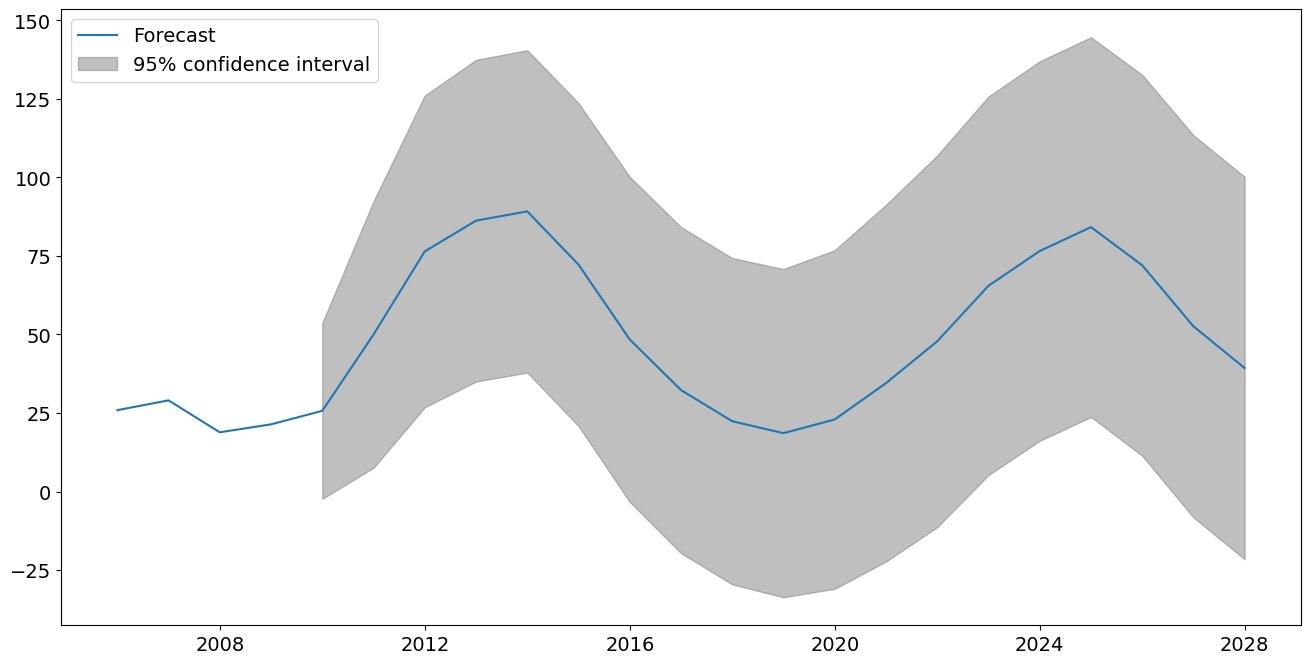
[6]:
pred = pandas_ar_res.predict(start="2005", end="2027")
print(pred)
2005-12-31    25.907501
2006-12-31    29.024373
2007-12-31    18.855729
2008-12-31    21.392012
2009-12-31    25.695092
2010-12-31    49.981886
2011-12-31    76.437566
2012-12-31    86.244709
2013-12-31    89.184663
2014-12-31    72.251362
2015-12-31    48.447259
2016-12-31    32.292122
2017-12-31    22.374099
2018-12-31    18.581657
2019-12-31    22.935657
2020-12-31    34.513168
2021-12-31    47.828469
2022-12-31    65.487766
2023-12-31    76.551575
2024-12-31    84.185043
2025-12-31    72.029019
2026-12-31    52.603134
2027-12-31    39.330875
Freq: YE-DEC, dtype: float64
[7]:
fig = pandas_ar_res.plot_predict(start="2005", end="2027")
最終更新日:
2025年01月28日