時系列フィルター
[1]:
%matplotlib inline
[2]:
import pandas as pd
import matplotlib.pyplot as plt

import statsmodels.api as sm
[3]:
dta = sm.datasets.macrodata.load_pandas().data
[4]:
index = pd.Index(sm.tsa.datetools.dates_from_range("1959Q1", "2009Q3"))
print(index)
DatetimeIndex(['1959-03-31', '1959-06-30', '1959-09-30', '1959-12-31',
               '1960-03-31', '1960-06-30', '1960-09-30', '1960-12-31',
               '1961-03-31', '1961-06-30',
               ...
               '2007-06-30', '2007-09-30', '2007-12-31', '2008-03-31',
               '2008-06-30', '2008-09-30', '2008-12-31', '2009-03-31',
               '2009-06-30', '2009-09-30'],
              dtype='datetime64[ns]', length=203, freq=None)
[5]:
dta.index = index
del dta["year"]
del dta["quarter"]
[6]:
print(sm.datasets.macrodata.NOTE)
::
    Number of Observations - 203

    Number of Variables - 14

    Variable name definitions::

        year      - 1959q1 - 2009q3
        quarter   - 1-4
        realgdp   - Real gross domestic product (Bil. of chained 2005 US$,
                    seasonally adjusted annual rate)
        realcons  - Real personal consumption expenditures (Bil. of chained
                    2005 US$, seasonally adjusted annual rate)
        realinv   - Real gross private domestic investment (Bil. of chained
                    2005 US$, seasonally adjusted annual rate)
        realgovt  - Real federal consumption expenditures & gross investment
                    (Bil. of chained 2005 US$, seasonally adjusted annual rate)
        realdpi   - Real private disposable income (Bil. of chained 2005
                    US$, seasonally adjusted annual rate)
        cpi       - End of the quarter consumer price index for all urban
                    consumers: all items (1982-84 = 100, seasonally adjusted).
        m1        - End of the quarter M1 nominal money stock (Seasonally
                    adjusted)
        tbilrate  - Quarterly monthly average of the monthly 3-month
                    treasury bill: secondary market rate
        unemp     - Seasonally adjusted unemployment rate (%)
        pop       - End of the quarter total population: all ages incl. armed
                    forces over seas
        infl      - Inflation rate (ln(cpi_{t}/cpi_{t-1}) * 400)
        realint   - Real interest rate (tbilrate - infl)
[7]:
print(dta.head(10))
             realgdp  realcons  realinv  realgovt  realdpi    cpi     m1  \
1959-03-31  2710.349    1707.4  286.898   470.045   1886.9  28.98  139.7
1959-06-30  2778.801    1733.7  310.859   481.301   1919.7  29.15  141.7
1959-09-30  2775.488    1751.8  289.226   491.260   1916.4  29.35  140.5
1959-12-31  2785.204    1753.7  299.356   484.052   1931.3  29.37  140.0
1960-03-31  2847.699    1770.5  331.722   462.199   1955.5  29.54  139.6
1960-06-30  2834.390    1792.9  298.152   460.400   1966.1  29.55  140.2
1960-09-30  2839.022    1785.8  296.375   474.676   1967.8  29.75  140.9
1960-12-31  2802.616    1788.2  259.764   476.434   1966.6  29.84  141.1
1961-03-31  2819.264    1787.7  266.405   475.854   1984.5  29.81  142.1
1961-06-30  2872.005    1814.3  286.246   480.328   2014.4  29.92  142.9

            tbilrate  unemp      pop  infl  realint
1959-03-31      2.82    5.8  177.146  0.00     0.00
1959-06-30      3.08    5.1  177.830  2.34     0.74
1959-09-30      3.82    5.3  178.657  2.74     1.09
1959-12-31      4.33    5.6  179.386  0.27     4.06
1960-03-31      3.50    5.2  180.007  2.31     1.19
1960-06-30      2.68    5.2  180.671  0.14     2.55
1960-09-30      2.36    5.6  181.528  2.70    -0.34
1960-12-31      2.29    6.3  182.287  1.21     1.08
1961-03-31      2.37    6.8  182.992 -0.40     2.77
1961-06-30      2.29    7.0  183.691  1.47     0.81
[8]:
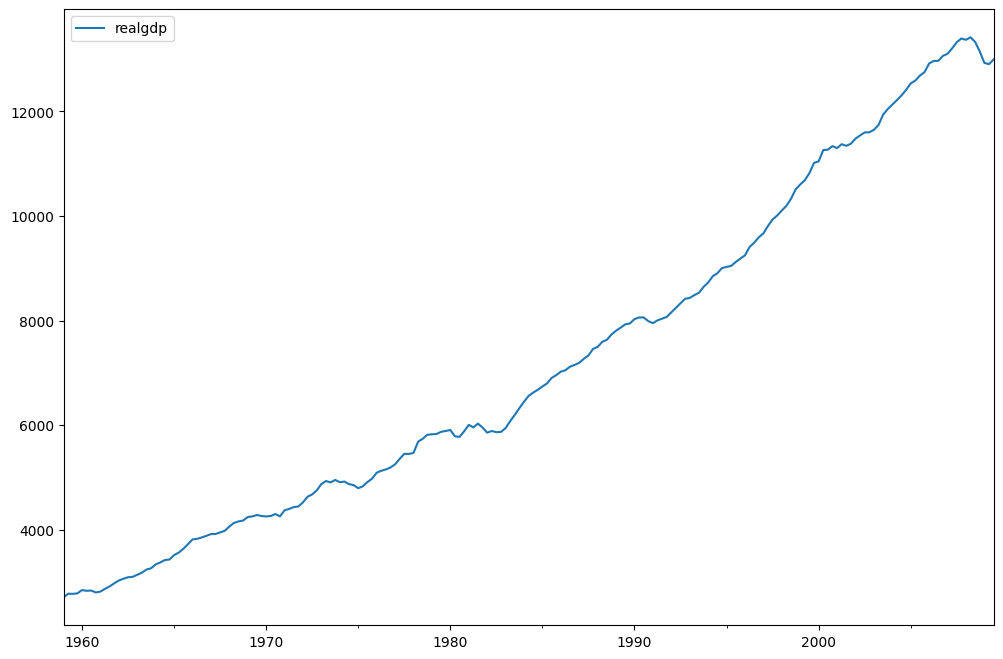
fig = plt.figure(figsize=(12, 8))
ax = fig.add_subplot(111)
dta.realgdp.plot(ax=ax)
legend = ax.legend(loc="upper left")
legend.prop.set_size(20)
ホドリック=プレスコットフィルター
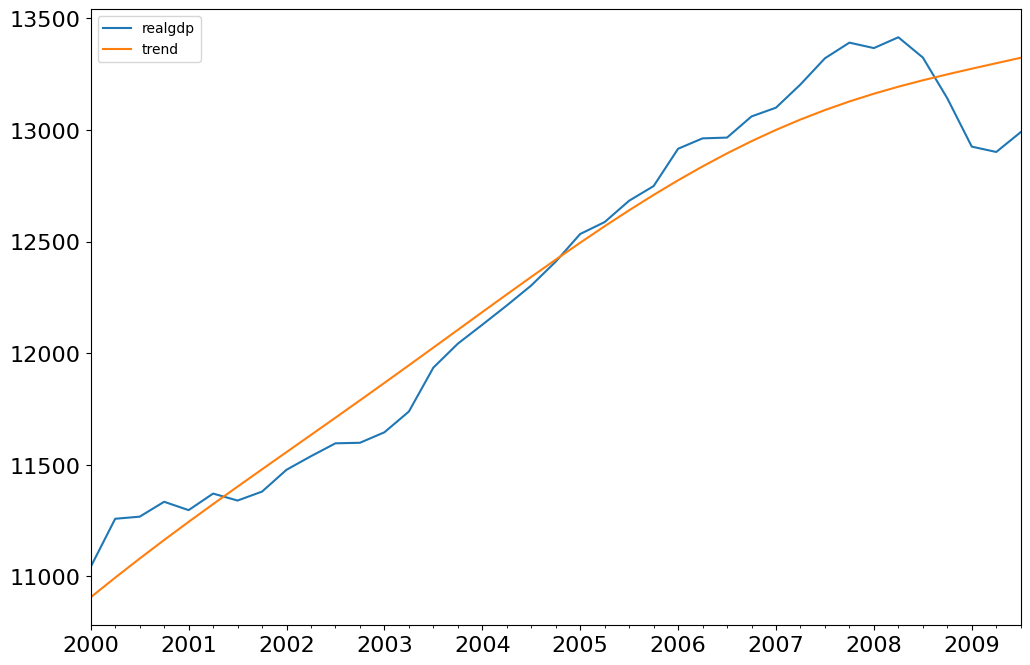
ホドリック=プレスコット・フィルターは、時系列 \(y_t\) をトレンド成分 \(\tau_t\) と周期成分 \(\zeta_t\) に分解します。
これらの成分は、以下の二次損失関数を最小化することで決定されます。
[9]:
gdp_cycle, gdp_trend = sm.tsa.filters.hpfilter(dta.realgdp)
[10]:
gdp_decomp = dta[["realgdp"]].copy()
gdp_decomp["cycle"] = gdp_cycle
gdp_decomp["trend"] = gdp_trend
[11]:
fig = plt.figure(figsize=(12, 8))
ax = fig.add_subplot(111)
gdp_decomp[["realgdp", "trend"]]["2000-03-31":].plot(ax=ax, fontsize=16)
legend = ax.get_legend()
legend.prop.set_size(20)
バクスター=キング近似バンドパスフィルター:インフレと失業率
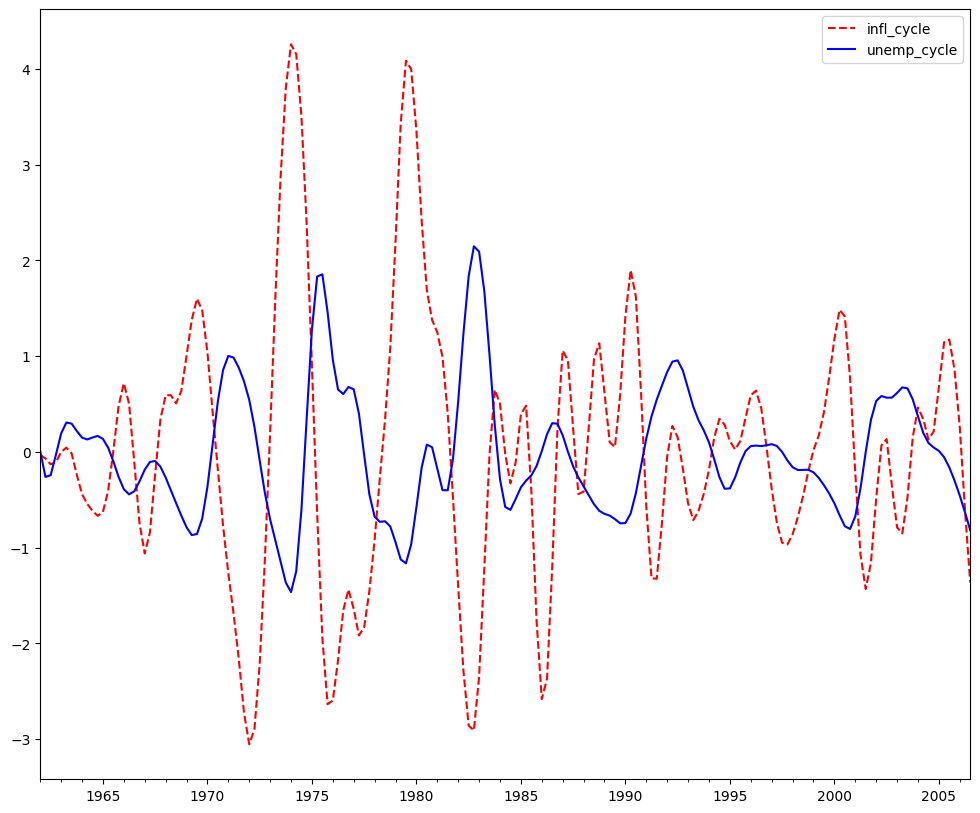
インフレと失業率が逆循環的であるという仮説を検証する。
バクスター・キング(Baxter-King)フィルターは、景気循環の周期性に対処することを目的としています。このバンドパスフィルターを時系列データに適用することで、景気循環より高頻度または低頻度の変動を含まない新しい時系列を生成します。具体的には、BKフィルターは対称移動平均の形式を取ります:
ここで、\(a_{-k}=a_k\) であり、\(\sum_{k=-K}^{K}a_k=0\) となるように調整することで、系列内のトレンド成分を除去し、もし系列が I(1) または I(2) の場合には定常性を持たせます。
補足として、フィルターの重みは以下のように決定されます:
ここで、\(\theta\) は重みがゼロになるように正規化するための定数です:
また、低周波数と高周波数のカットオフの周期性は次式で定義されます:
ここで、\(P_L\) と \(P_H\) は低周波数と高周波数の周期を示します。バーンズ(Burns)とミッチェル(Mitchell)の米国景気循環に関する研究に基づき、循環の期間が通常 1.5年から 8年続くことを考慮して、デフォルトでは \(P_L=6\)(月単位での短い周期)および \(P_H=32\)(月単位での長い周期)が使用されます。
[12]:
bk_cycles = sm.tsa.filters.bkfilter(dta[["infl", "unemp"]])
両端でK個の観測値を失います。四半期データの場合、K=12を使用することが推奨されています。
[13]:
fig = plt.figure(figsize=(12, 10))
ax = fig.add_subplot(111)
bk_cycles.plot(ax=ax, style=["r--", "b-"])
[13]:
<Axes: >
クリスティアーノ=フィッツジェラルド近似バンドパスフィルター:インフレと失業
クリスティアノ=フィッツジェラルドフィルターは、BKフィルターの一般化であり、そのため加重移動平均としても見ることができます。ただし、CFフィルターは\(t\)を中心に非対称であり、また、全ての系列を使用します。彼らのフィルターの実装は、以下の重みの計算を含みます。
ここで、\(t=3,4,...,T-2\) であり、
\(\tilde B_{T-t}\) および \(\tilde B_{t-1}\) は、\(B_{j}\) の線形関数であり、\(t=1,2,T-1,T\) の値もほぼ同様に計算されます。\(P_{U}\) および \(P_{L}\) は、上記のように説明され、同様の解釈がなされます。
CFフィルターは、ランダムウォークに従う可能性のある系列に適しています。
[14]:
print(sm.tsa.stattools.adfuller(dta["unemp"])[:3])
(-2.5364584673346324, 0.10685366457233564, 9)
[15]:
print(sm.tsa.stattools.adfuller(dta["infl"])[:3])
(-3.0545144962572364, 0.03010762086348588, 2)
[16]:
cf_cycles, cf_trend = sm.tsa.filters.cffilter(dta[["infl", "unemp"]])
print(cf_cycles.head(10))
            infl_cycle  unemp_cycle
1959-03-31    0.237927    -0.216867
1959-06-30    0.770007    -0.343779
1959-09-30    1.177736    -0.511024
1959-12-31    1.256754    -0.686967
1960-03-31    0.972128    -0.770793
1960-06-30    0.491889    -0.640601
1960-09-30    0.070189    -0.249741
1960-12-31   -0.130432     0.301545
1961-03-31   -0.134155     0.788992
1961-06-30   -0.092073     0.985356
[17]:
fig = plt.figure(figsize=(14, 10))
ax = fig.add_subplot(111)
cf_cycles.plot(ax=ax, style=["r--", "b-"])
[17]:
<Axes: >
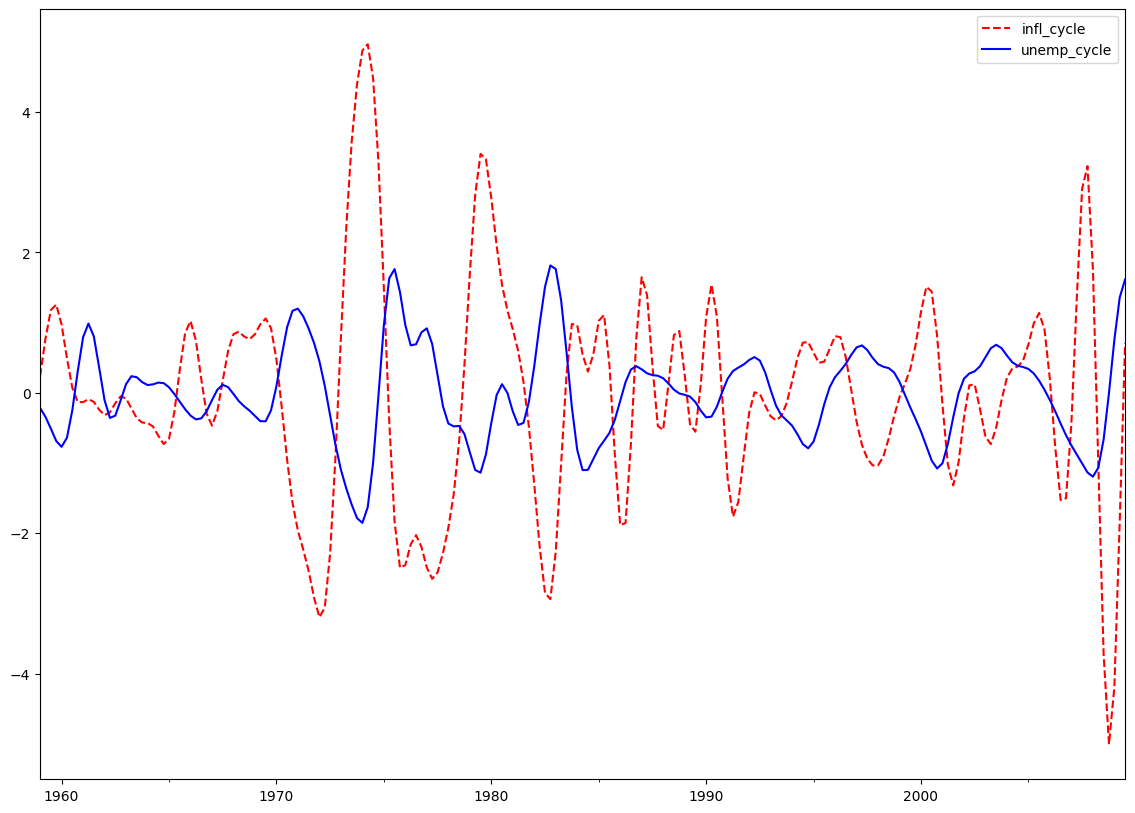
フィルタリングは、a priori(事前に)ビジネスサイクルが存在すると仮定しています。この仮定のため、多くのマクロ経済モデルは、フィルタリングされた系列の特性を再現するのではなく、インパルス応答関数の形状に一致するモデルを作成しようとします。VARノートブックを参照してください。